AI-gesprek
Note
Deze documentatie is vertaald met behulp van AI-ondersteunde machinevertaling. Vertalingen worden geleverd 'zoals ze zijn', zonder garantie van de juistheid ervan. De Engelse versie van deze inhoud is de officiële en leidende versie.
AI-gesprekken zijn bedoeld om een onderwerp of scenario te verkennen met een AI-persona die is gedefinieerd door je docent. Je docent beoordeelt je gesprek met de AI-persona nadat je klaar bent met het gesprek.
Je docent wil bijvoorbeeld dat je meer nadenkt over een historische gebeurtenis in je cursus. Je docent creëert een AI-persona om het onderwerp met jou te bespreken. Je docent definieert de gesprekskenmerken van de AI-persona, zoals het definiëren van de AI-persona als ondersteunend. Na de interactie met de AI-persona wordt je gevraagd om na te denken over hoe de interactie je begrip van het onderwerp heeft verbeterd.
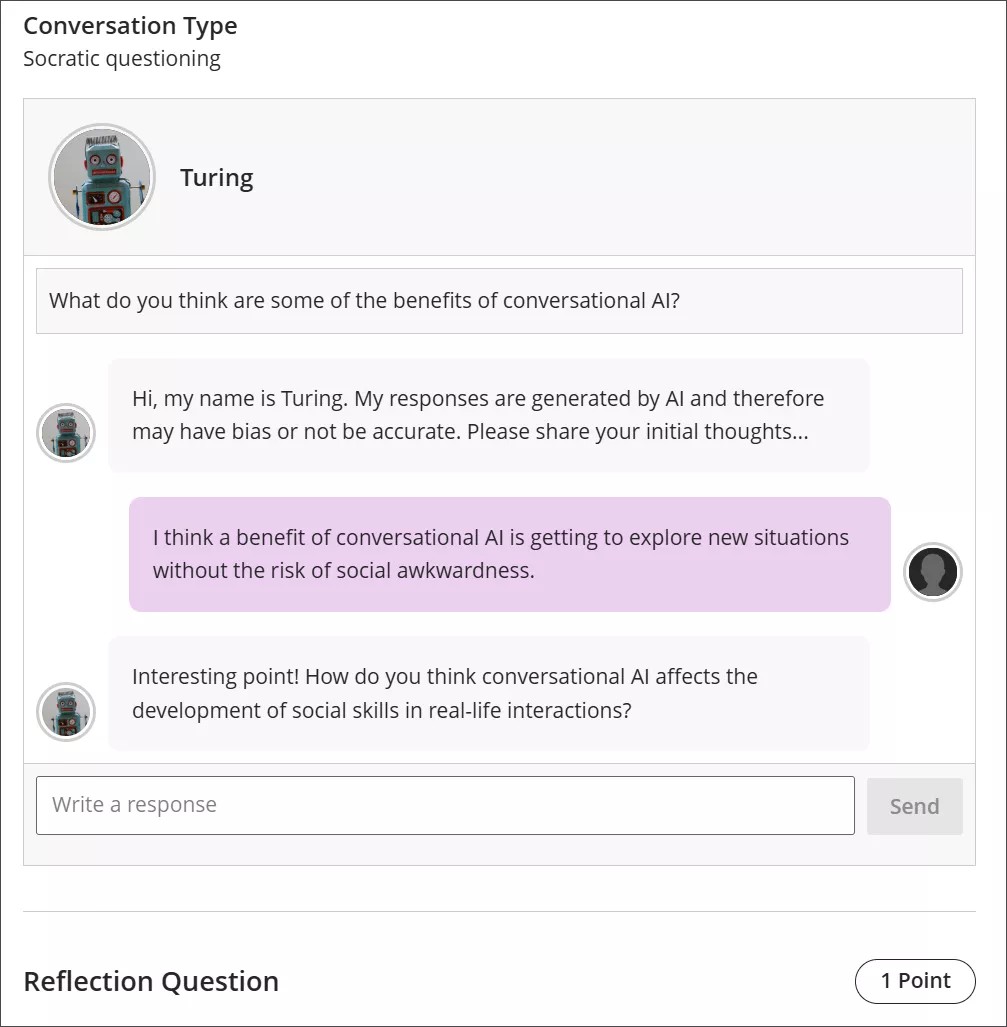
Conversation types
Socratic Questioning conversations encourage you to think critically through continuous questioning. The AI persona won’t tell you that you have a right or wrong answer. It gives you a series of questions so you can explore the topic. When you feel like you’ve fully considered the topic, you can move on to the reflection question.
Role Play conversations are for playing out a scenario with an AI persona. You can get experience with new situations in a way that is close to real life, such as workplace interactions and preparing for interviews.
Pulse Quiz conversations ask you quickfire questions about material you have covered. A host greets you, says how many questions the quiz contains, asks them one at a time, and responds to each answer before moving on. At the end, the host summarizes how you did. Questions are generated as you go, so another student taking the same quiz won’t get the same questions.
Start a conversation
Open the AI Conversation from your course and select Start attempt, then select Start conversation. The conversation opens in its own view with more room for the exchange, and the settings and assessment details are hidden while you work.
The notice explaining that responses are AI-generated and may be inaccurate or contain bias stays visible while you work.
Take part in a conversation
Als u wilt communiceren met de AI-persona, voert u uw antwoord in het tekstveld in.
Als u een regeleinde wilt maken, gebruikt u de Entertoets op het toetsenbord.
Selecteer de knop Verzenden of gebruik Shift + Enter om uw antwoord te verzenden.
AI-persona's kunnen vooroordelen hebben of onnauwkeurig zijn. Gebruik uw gezond verstand in uw reacties op de AI-persona en uw reflectie op het gesprek. Als u vooroordelen of onnauwkeurigheden in uw interactie met de AI-persona vaststelt, kunt u dit opnemen in uw reflectie op het gesprek.
Conversation language
Your instructor can set the language a conversation is conducted in. When a language is enforced, the whole conversation is in that language from the first message onward. You can’t change it partway through: if you ask the AI to continue in a different language, it declines and carries on in the language your instructor set.
Reflect on the conversation
AI personas may have bias or be inaccurate. Use your best judgment in your responses to the AI persona and your reflection on the conversation. If you identify any bias or inaccuracies in your interaction with the AI persona, you can include this in your reflection on the conversation.
Opmerking
Het wettige, ethische en verantwoordelijke gebruik van AI is een belangrijke prioriteit voor Anthology en voor de ontwikkeling van de functie AI-gesprek. Voor meer informatie over de benadering van AI van Anthology, bezoekt u ons Trust Center.