Curricular Structure
Curricular structure extends the institutional hierarchy by defining how learning is organized and delivered across the institution. While the institutional hierarchy establishes the administrative framework (such as colleges, schools, and departments), curricular structure represents the academic pathways within that framework—programs, courses, and their relationships. Together, these structures create a connected foundation that supports consistent alignment, meaningful measurement, and aggregated reporting from the course level through the institution.
Institutional Hierarchy and Curricular Structure in Blackboard
Institutional hierarchy and curricular structure in Blackboard—encompassing institutional nodes (or units), subjects, courses, term types, and programs—provide the essential foundation for many different functionality in Blackboard like the Learning Object Repository and data aggregation and reporting with Outcomes, Ally, and Illuminate.
For Outcomes, by mirroring the way your institution organizes teaching and learning, these structures allow outcomes, skills, and competencies to be accurately aligned and meaningfully related across every level of the academic experience. This framework not only ensures consistency and integrity in data, but also enables powerful connections between curriculum design, student achievement, and institutional goals—fueling deeper insights for teaching, learning, and continuous improvement.
Not every institution is organized the same way. The following images depict examples of institutional organization.
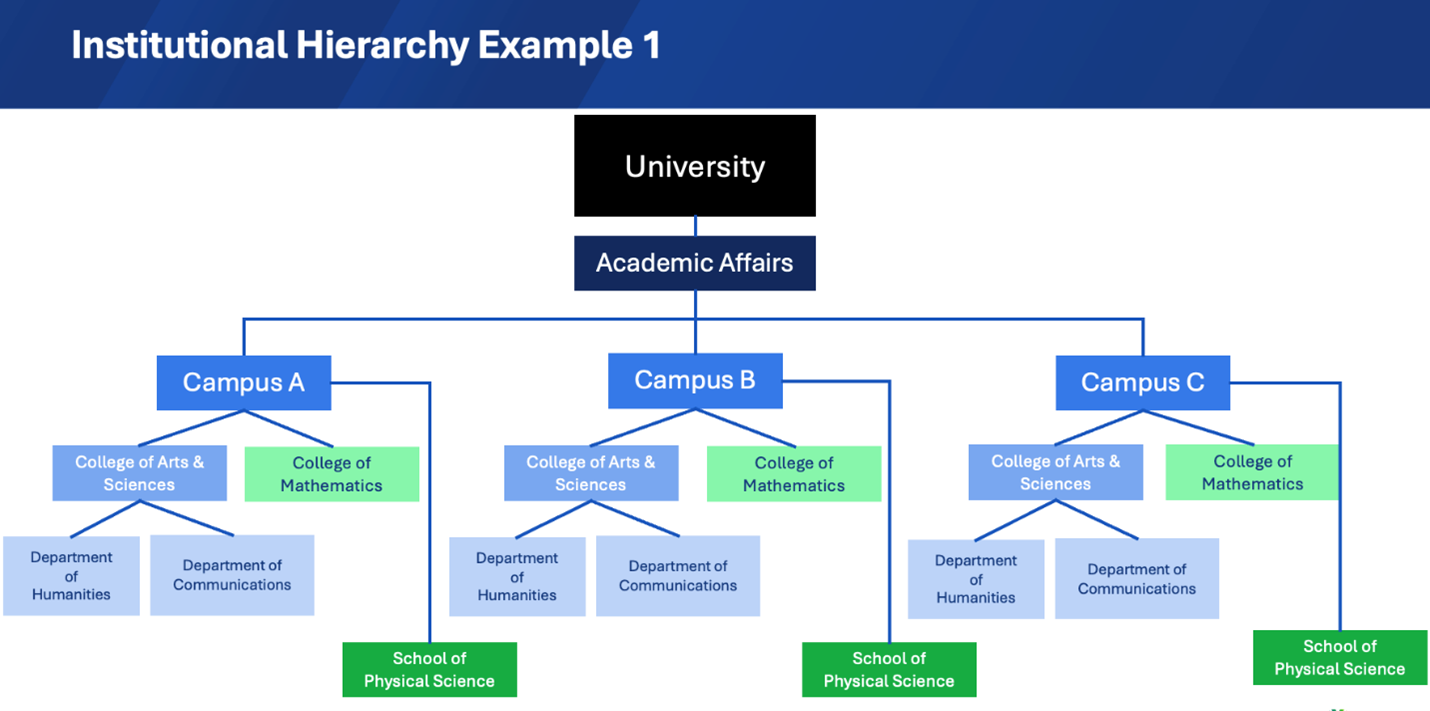
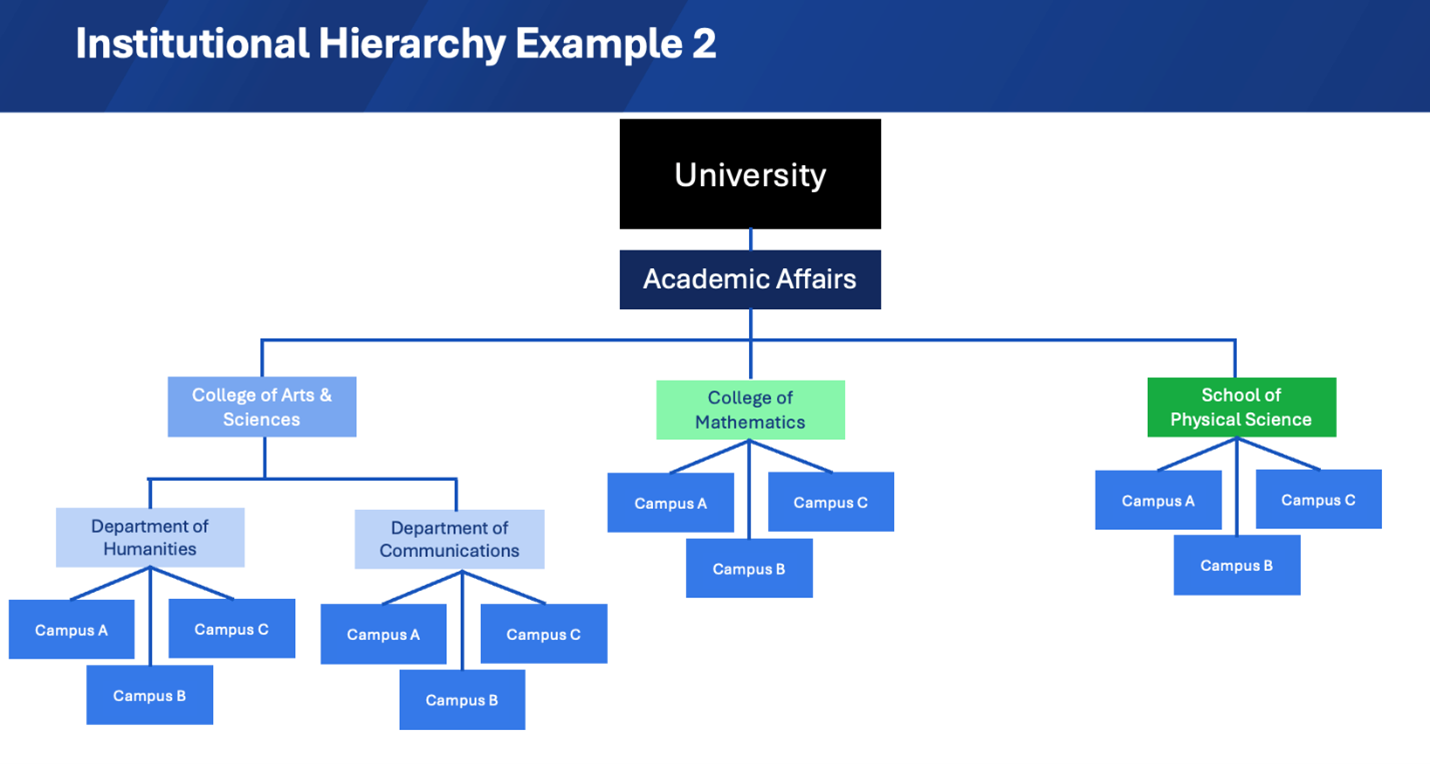
Where does Institutional Hierarchy End and Curricular Structure begin?
Here is our suggestion:
Institution: XYZ University – NODE OF INSTITUTIONAL HIERARCHY
Academic Division/School: School of Engineering – NODE OF INSTITUTIONAL HIERARCHY
Department: Department of Computer Science – NODE OF INSTITUTIONAL HIERARCHY
Program/Degree: Bachelor of Science in Computer Science - NODE IN INSTITUTIONAL HIERARCHY if Program/Degree is a direct academic pathway within a Department or Academic Unit.
PROGRAM/CURRICULAR STRUCTURE if Program/Degree is an academic pathway within many Department or Academic Unit. Where the Subjects within the Program need to be assigned to multiple Programs.
Subject: Software Engineering - CURRICULAR STRUCTURE/SUBJECT
Courses: Introduction to Programming, Software Design, Algorithms, etc. - CURRICULAR STRUCTURE/COURSE
Why Use Subjects or Programs Instead of Creating Nodes in the Institutional Hierarchy?
Using subjects and programs provides valuable metadata on courses that powers deeper alignments, analytics, and reporting across Blackboard functionality such as Outcomes. While the Institutional Hierarchy is highly flexible and can be customized to fit many organizational structures, designating subjects or programs as simple nodes within the hierarchy limits the system’s ability to recognize and relate them consistently across the institution.
By defining subjects and programs using their dedicated structures, Blackboard can understand their relationships institution-wide, allowing for meaningful comparisons, aggregated reporting, and insights that span departments, programs, and courses. This structured approach ensures consistency, accuracy, and richer data for institutional analysis and decision-making.